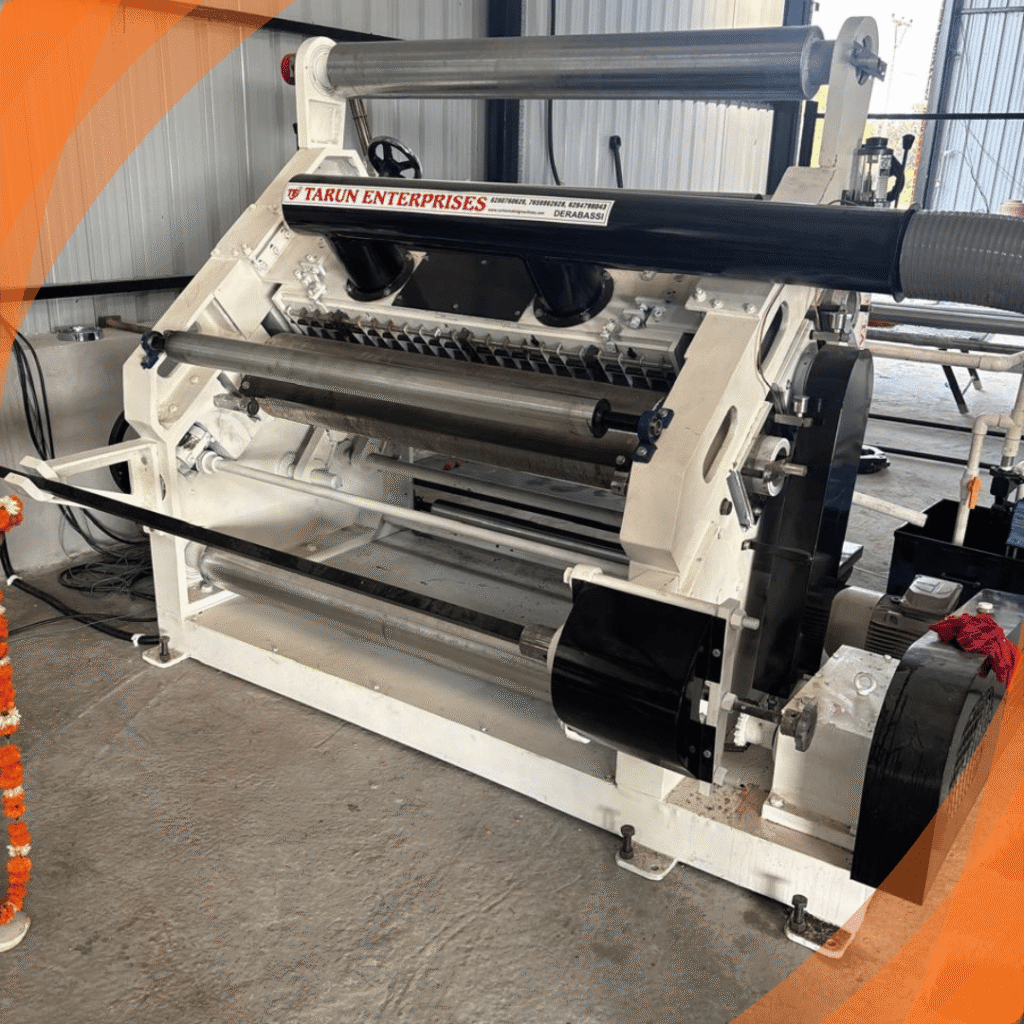
A fully automatic flute laminator joins a printed top sheet to corrugated board. For packaging manufacturers, the useful question is not simply whether a machine is automatic. It is whether it can handle your sheet dimensions, flute grades, artwork registration and daily order mix with repeatable results. Tarun Enterprises lists its fully automatic flute laminator for board-to-sheet and board-to-board work, with servo flute advance and glue circulation.
Where flute lamination fits in production
In a typical printed carton job, the top sheet carries the brand artwork while the corrugated board supplies structure. The laminator feeds these materials, applies adhesive and brings them together. The finished laminated board then moves to cutting, creasing, folding or another conversion step. If the two layers shift, printed edges and die-cut positions can become inconsistent. The machine therefore needs steady feeding and registration as well as suitable glue application.
Start with the actual materials
List the smallest and largest top-sheet sizes you run, the board dimensions and the flute profiles used. The product listing mentions A, B, C, D, E and F flute compatibility, but the practical choice still depends on your exact board and sheet combinations. Share sample materials and finished-packaging requirements when asking for a demonstration or quotation. Discuss whether the job is printed sheet to corrugated board, board to board, or both.
Check registration and feeding
Ask how the top sheet and flute board are aligned through feeding and bonding. Review the tolerance your customers expect around printed graphics and die-cut edges. On a live trial, inspect several consecutive boards, including the first pieces after a size change. Look for skew, exposed edges, bubbles and inconsistent placement. A quoted maximum speed is less useful than stable output on your real material.
Examine glue control and cleanup
Too little adhesive can cause weak bonding; excess adhesive can mark sheets, raise material use or complicate downstream work. Discuss adhesive type, application control, circulation and cleaning steps with the supplier. The Tarun Enterprises product page describes recyclable glue circulation. Ask the team to explain the normal setup and cleaning routine for your jobs rather than assuming every stock behaves alike.
Plan the surrounding line
The laminator must fit your upstream printing and board supply and your downstream cutting or finishing. Check feed orientation, stacking space, operator access, power requirement and maintenance clearances. A layout drawing should show how sheets arrive and where laminated output waits before the next operation. Compare these details with your installation preparation checklist.
Questions for a supplier quotation
- Which top-sheet and corrugated-board sizes and grades are planned?
- What registration accuracy and visual quality does the finished pack require?
- How many sheets per shift are needed, including job changes?
- What floor area, power and operator access are available?
- What trial materials can you provide for evaluation?
Ask the supplier to identify the exact proposed configuration, included accessories, commissioning scope and support arrangements in writing.
Frequently asked questions
Can the machine laminate different flute profiles?
The listed Tarun Enterprises model supports A, B, C, D, E and F flutes. Confirm your specific board thickness and sheet pairing before ordering.
Is automatic feeding enough to guarantee good registration?
No. Material condition, setup and machine alignment all matter. Check repeated samples from the actual job at a realistic production pace.
What should I send for a useful quotation?
Send maximum and minimum sheet sizes, flute types, top-sheet stock, daily output target, factory location and sample job photographs.
What happens after lamination?
The bonded board usually moves to die cutting, slotting or other carton finishing according to the pack design. Plan the handoff when sizing your line.
Request a machine recommendation
For a configuration and quotation suited to your cartons, contact Tarun Enterprises or call +91 62807 60628. Share your sample sheet, flute type, dimensions and output target.